
What is Sports Arbitrage?
Sports arbitrage (or "arbing") is the practice of betting on all possible outcomes of a game across different sportsbooks, exploiting the fact that each book sets odds independently — guaranteeing a profit regardless of who wins.
Here's how it works:
Why do different odds exist? As we discussed in previous articles, sportsbooks set their own lines based on their own models, the action they're taking, and how they want to balance liability. A book getting heavy Yankees action might shade the odds to attract Dodgers bets, while another book does the opposite. This creates gaps you can exploit.
The key math: Convert each book's odds to an implied probability. If the sum of all implied probabilities across books is less than 100%, an arb exists. That gap is your guaranteed profit.
Let’s assume Arsenal (Odds of -110) is Playing Chelsea (Odds of +120).
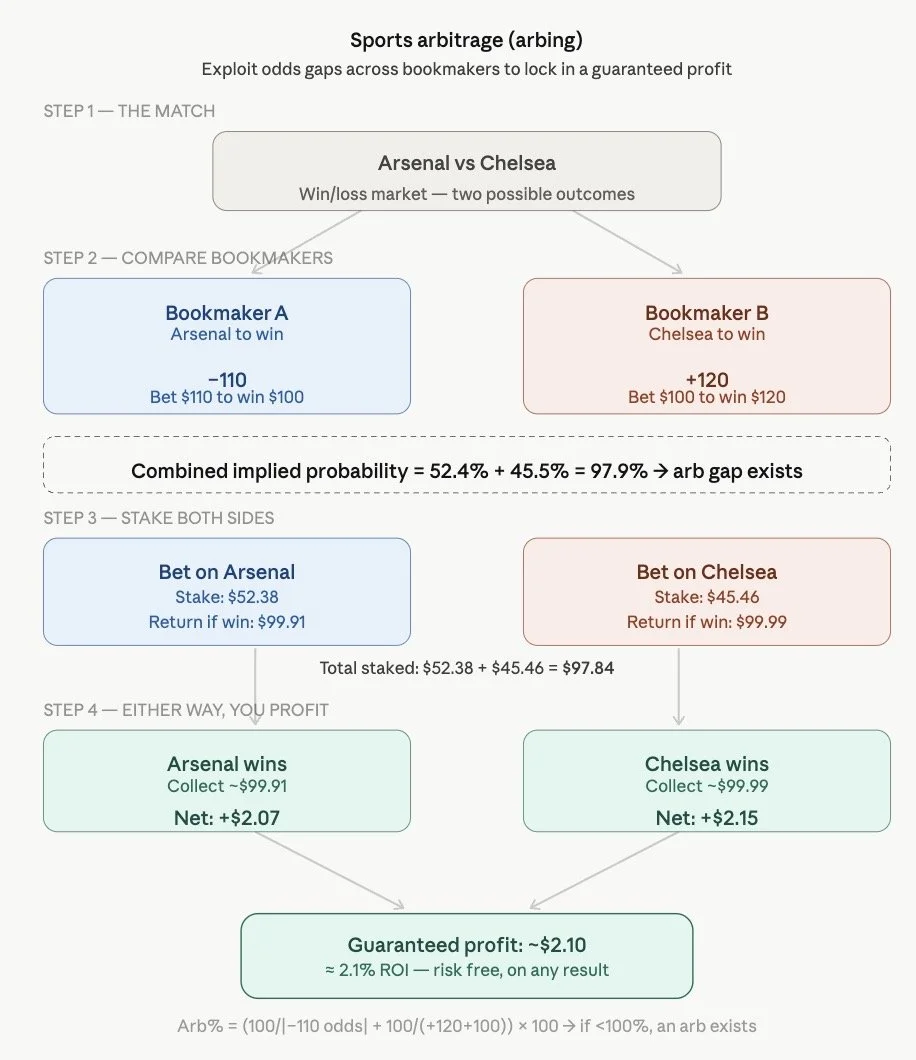
With a $1,000 total stake at those odds, you'd walk away with about $21 profit no matter the outcome — a ~2.1% guaranteed return.
Why it's hard in practice:
Odds move in real time. The mispriced odds might be gone by the time you place the second bet.
Books will limit or close accounts they identify as arbitrage bettors.
It requires accounts at multiple books with funds already deposited and ready.
The margins are thin — transaction costs, withdrawal fees, or even a small odds shift can erase the edge entirely.
That said, professional arbers are able to move quickly, treating betting essentially like a low-risk yield strategy rather than gambling.